Let the Ceiling Clock Out First: A Softer Evening for Early Sunsets
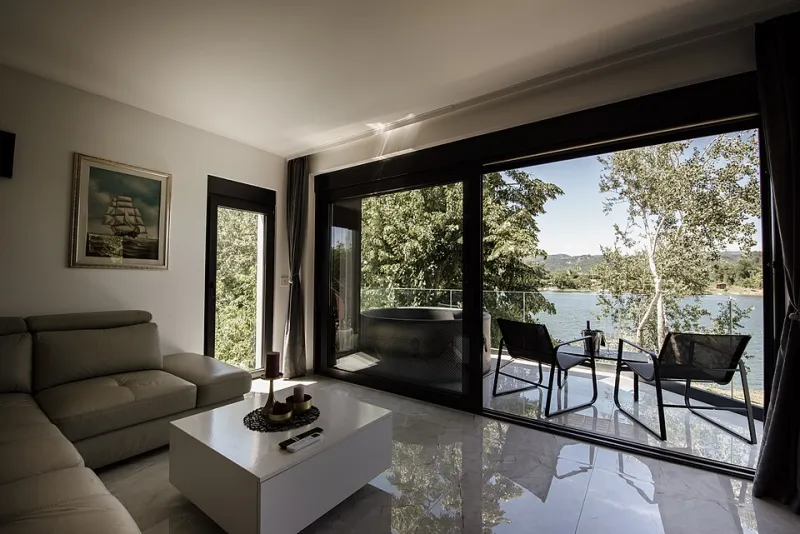
Photo: Shixart1985, CC BY 2.0, via Wikimedia Commons
In much of the U.S., late fall means the sun can slide away before the dinner dishes are even dry. You walk into the kitchen at 5 p.m., flip the switch by the door, and suddenly the room looks like a cafeteria at noon. The ceiling light does its job — bright, even, efficient — but it also sends a pretty clear message to your body: we are still open for business.
That message is worth paying attention to. Not because overhead lighting is evil, and not because one lamp will fix your sleep forever, but because the last stretch of the evening is a transition. And transitions go more smoothly when the room agrees with them.
The ceiling is a daytime tool
Overhead lighting is designed for tasks. It fills a room, reduces shadows, and helps you see what you are chopping. That is genuinely useful. The trouble is that most of us leave it on long after the chopping is done, often while we are folded into the couch with a phone or a streaming queue.
From a mind-body perspective, light is information. Bright, overhead, blue-rich light tends to read as daytime. Lower, warmer, more localized light reads as evening. Research on light timing and circadian rhythms supports the general idea that bright light late in the evening can make the body's wind-down less distinct. You do not need to memorize the science to use the principle: if the room still looks like midday, your body may not get a strong signal that the day is closing.
There is also a simpler, more felt effect. Overhead light flattens a room. One lamp creates pools and shadows, corners and edges. The space feels smaller, more contained, more like somewhere you are settling rather than somewhere you are performing tasks. That shift in the room can become a shift in you.
What a dimmer room actually changes
This is not about achieving perfect darkness at 6 p.m. or turning your living room into a candlelit spa. It is about creating a slope instead of a cliff. Most of us go from full overhead brightness to bed with very little in between. A softer evening gives the nervous system a middle ground.
In practical terms, a lower lamp does a few things at once. It reduces the glare that comes from a bright ceiling bouncing off dark windows. It lowers the overall light level without making the room unusable. And it changes the visual cue of the room, which can gently nudge behavior — you might reach for a book instead of a laptop, or putter instead of power through one more work task.
None of this is a treatment for insomnia or seasonal affective disorder. If your mood or sleep changes significantly with the seasons, that is worth discussing with a clinician. Think of this as everyday environmental hygiene: a small, low-stakes way to make the evening feel like an evening.
A three-night experiment, no purchases required
You do not need a new lamp, a smart bulb, or a documentary about circadian biology. Use what is already in your house. The experiment is simply to notice, swap, and repeat.
Night 1: Take the baseline
At sunset, or right after dinner, walk through your main room and count the light sources. Notice which ones are overhead, which are at eye level, and which are lower. Then leave everything as usual. Around 8 p.m., check in with three things: your jaw, your shoulders, and your screen. Are you clenching? Hunched? Is the room bright enough to do surgery, or is it just bright enough to make you feel vaguely wired?
No need to fix anything yet. You are just gathering data.
Night 2: Swap one ceiling for one lamp
Pick the room where you spend the last hour or two of the evening. Turn off the main overhead light and turn on a single lamp that sits lower than your eye level, ideally with a warmer bulb. If you have a dimmer, use it. If you do not, angle the lamp so the light falls on a wall or the floor rather than straight into your face.
Keep task lighting where you genuinely need it. If you are cooking, reading fine print, or helping a child with homework, use the light that lets you do the task safely. The goal is not dimness for its own sake. It is a softer default once the task is done.
Night 3: Give the ceiling a curfew
One hour before bed, make the overhead lights off-limits in your main living space. One lamp only. If you are on a screen, lower the brightness and keep the screen lower than eye level if you can. If you are not on a screen, notice what the room invites you to do. Maybe nothing. That is allowed.
What to track without turning it into a spreadsheet
You do not need a sleep tracker or a journal with seventeen columns. Just notice a few things each night. Did your shoulders drop when the big light went off? Did you reach for your phone more or less? Did the room feel like a place to be, or a place to wait until bed? Did you fall asleep faster, or wake up less, or neither?
Three nights will not give you a research study. It will give you a felt sense of whether this cue is useful for you. That is enough.
When one lamp is not the answer
There are plenty of reasons to keep the overhead light on: safety, vision, kids, pets, older adults in the house, or a task that genuinely needs even brightness. Use the light you need. The ritual is not a rule, and a darkened room should never be a tripping hazard.
The point is to make the last hour of the evening look a little different from the middle of the day. At Bhuwell, we are fond of wellness practices that fit the room you actually live in — no renovation, no cart full of gadgets, just a small environmental cue you can repeat.
So tonight, after the plates are cleared, try letting the ceiling clock out first. One lamp is enough to start.